
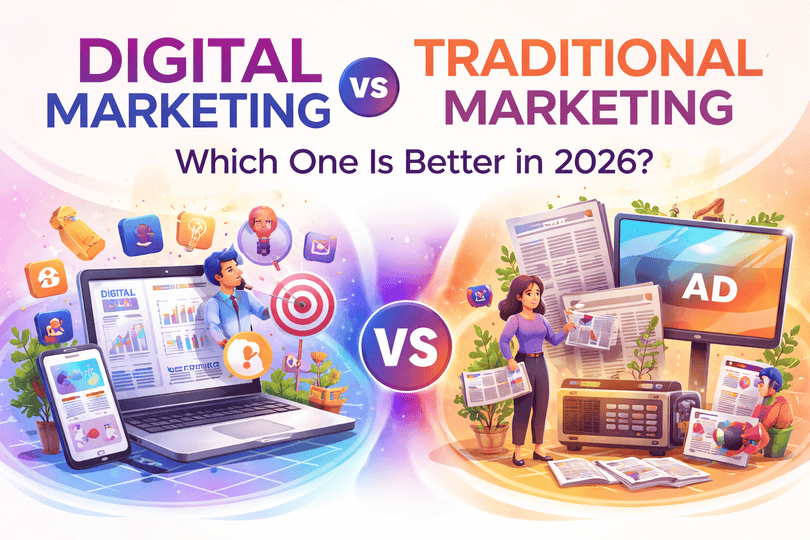
Marketing has changed a lot over the years. What worked 10 years ago may not work today. If you run a small business, you may be confused about where to invest your time and money.
Should you go for newspaper ads and banners?
Or should you focus on Instagram, Google, and websites?
Understanding the difference between Digital Marketing vs Traditional Marketing will help you make the right decision.
Exploring Digital Marketing vs Traditional Marketing will provide you with insights into the effectiveness of both methods.
In this guide, you will learn the 10 most important differences in a simple and clear way.
Contents
- 1 What Is Digital Marketing?
- 2 What Is Traditional Marketing?
- 2.1 1. Cost: Budget-Friendly vs Expensive
- 2.2 2. Reach: Global vs Limited
- 2.3 3. Targeting: Smart vs General
- 2.4 4. Measurability: Clear Data vs No Tracking
- 2.5 5. Engagement: Two-Way vs One-Way
- 2.6 6. Speed: Instant vs Time-Consuming
- 2.7 7. Flexibility: Easy to Change vs Hard to Modify
- 2.8 8. Conversion Rate: Higher vs Lower
- 2.9 9. Longevity: Long-Term Value vs Short-Term Impact
- 2.10 10. Trust: Social Proof vs Brand Awareness
- 3 Digital Marketing vs Traditional Marketing: Quick Comparison
- 4 Which Marketing (Digital Marketing vs Traditional Marketing) Is Best for Small Businesses in 2026?
- 5 Simple Digital Marketing Plan for Small Businesses
- 6 Common Mistakes to Avoid
- 7 FAQs (People Also Ask)
- 8 Final Thoughts
What Is Digital Marketing?
Digital marketing means promoting your business using the internet. It helps you connect with people through their phones, laptops, and tablets.
Some popular digital marketing channels include:
- Search Engine Optimization (SEO)
- Social Media Marketing (Instagram, Facebook)
- Google Ads and paid campaigns
- Email marketing
- Content marketing (blogs, videos)
Today, most customers search online before buying anything. That is why digital marketing is becoming more powerful.
What Is Traditional Marketing?
Traditional marketing refers to offline ways of promoting your business. These methods have been used for many years.
Examples include:
- Newspaper advertisements
- TV commercials
- Radio ads
- Billboards
- Pamphlets and flyers
These methods still work in some situations, especially for local visibility, but they have limitations.
1. Cost: Budget-Friendly vs Expensive
One of the biggest differences between digital and traditional marketing is cost.
Digital Marketing
Digital marketing is ideal for small businesses because it is affordable.
- You can run ads with a small budget
- Social media is mostly free
- SEO brings long-term traffic without paying for every click
Even with a limited budget, you can reach thousands of people.
Traditional Marketing
Traditional marketing requires a large investment.
- TV ads are very expensive
- Newspaper ads need repeated spending
- Printing and distribution cost money
Small businesses often find it hard to afford these methods.
Final Thought: Digital marketing is more cost-effective.
Understanding Digital Marketing vs Traditional Marketing helps you allocate your budget effectively.
2. Reach: Global vs Limited
Digital Marketing
Deciding between Digital Marketing vs Traditional Marketing depends on your target audience.
With digital marketing, your business is not limited by location.
- You can reach customers worldwide
- Your website is open 24/7
- Social media connects you to a global audience
Even a small business can go global.
Traditional Marketing
Traditional marketing is location-based.
- Newspaper ads reach only local readers
- Billboards are limited to one area
Final Thought: Digital marketing offers unlimited reach.
3. Targeting: Smart vs General
Digital Marketing
Digital marketing allows you to target the right audience.
You can choose people based on:
- Age
- Gender
- Interests
- Location
- Online behavior
For example, if you sell bridal jewelry, you can target women who are planning weddings.
Traditional Marketing
When considering Digital Marketing vs Traditional Marketing, businesses must assess their goals and resources.
Traditional marketing targets everyone.
- Ads are shown to a broad audience
- Many people may not be interested
Final Thought: Digital marketing is more precise.
The comparison of Digital Marketing vs Traditional Marketing offers insights into their effectiveness.
4. Measurability: Clear Data vs No Tracking
In the debate of Digital Marketing vs Traditional Marketing, flexibility is a crucial factor to consider.
Digital Marketing
One of the biggest advantages is tracking.
You can measure:
- Website visits
- Clicks
- Sales
- Customer behavior
This helps you understand what works and what doesn’t.
Traditional Marketing
Tracking is difficult.
- You cannot know how many people saw your ad
- No clear data on results
Final Thought: Digital marketing is data-driven.
5. Engagement: Two-Way vs One-Way
Digital Marketing
Customers can interact with your brand.
- Comment on posts
- Send messages
- Share content
- Leave reviews
This builds strong relationships.
Traditional Marketing
Communication is one-way.
- Customers cannot respond instantly
- No direct interaction
Final Thought: Digital marketing builds better engagement.
6. Speed: Instant vs Time-Consuming
Digital Marketing
Digital campaigns are fast.
- Ads can go live in minutes
- Social media posts are instant
You can start getting results quickly.
Traditional Marketing
Traditional marketing takes time.
- Printing takes days
- Booking TV or radio takes planning
Final Thought: Digital marketing is faster.
7. Flexibility: Easy to Change vs Hard to Modify
Digital Marketing
You can change campaigns anytime.
- Edit ads instantly
- Pause or restart campaigns
- Test different strategies
Traditional Marketing
Changes are difficult.
- Printed ads cannot be edited
- TV ads need re-shooting
Final Thought: Digital marketing is flexible.
8. Conversion Rate: Higher vs Lower
Digital Marketing
Digital marketing gives better conversions.
- You target interested people
- Content is personalized
This increases the chances of sales.
Traditional Marketing
Lower conversion rates.
- Many viewers are not interested
- Less relevance
Final Thought: Digital marketing performs better.
9. Longevity: Long-Term Value vs Short-Term Impact
Digital Marketing
Content lasts longer.
- Blogs can rank for years
- Videos keep getting views
- Social media posts can go viral
Traditional Marketing
Short lifespan.
- Newspaper ads last one day
- Flyers are quickly discarded
Understanding Digital Marketing vs Traditional Marketing will help optimize your advertising strategies.
Final Thought: Digital marketing provides long-term value.
10. Trust: Social Proof vs Brand Awareness
Digital Marketing
Trust is built through:
- Reviews
- Ratings
- Testimonials
Customers trust other customers.
Traditional Marketing
Focuses on visibility.
Both Digital Marketing vs Traditional Marketing require careful planning for success.
- Builds brand awareness
- But lacks personal trust signals
Final Thought: Digital marketing builds stronger trust.
Digital Marketing vs Traditional Marketing: Quick Comparison
| Feature | Digital Marketing | Traditional Marketing |
|---|---|---|
| Cost | Low | High |
| Reach | Global | Local |
| Targeting | Accurate | Broad |
| Tracking | Easy | Difficult |
| Engagement | Interactive | One-way |
| Speed | Fast | Slow |
| Flexibility | High | Low |
| Conversion | High | Low |
| Lifespan | Long | Short |
| Trust | High | Moderate |
Which Marketing (Digital Marketing vs Traditional Marketing) Is Best for Small Businesses in 2026?
In 2026, digital marketing is the best choice for most small businesses.
Here’s why:
- It fits small budgets
- It reaches the right audience
- It gives measurable results
- It grows with your business
However, traditional marketing can still help in local promotions.
Best approach: Combine both, but focus more on digital.
Simple Digital Marketing Plan for Small Businesses
If you are just starting, follow this simple plan:
1. Create a Website
Your website is your online store.
2. Start Social Media
Be active on Instagram and Facebook.
3. Focus on SEO
Rank your website on Google.
4. Run Ads
Start small and scale gradually.
5. Collect Reviews
Ask happy customers for feedback.
Common Mistakes to Avoid
- Ignoring online marketing
- Spending too much on offline ads
- Not tracking results
- Posting without a plan
- Targeting the wrong audience
FAQs (People Also Ask)
What is the difference between digital marketing vs traditional marketing?
Digital marketing uses online platforms, while traditional marketing uses offline methods like TV and newspapers.
Is digital marketing better in 2026?
Yes, it is more effective due to better targeting, lower cost, and measurable results.
Can small businesses use both methods?
Yes, combining both can improve results.
Why is digital marketing important?
It helps businesses reach more customers and increase sales at a lower cost.
Does traditional marketing still work?
Yes, but it is less effective compared to digital marketing for most businesses today.
You can check this link for Digital Marketing vs. Social Media Marketing
Final Thoughts
The difference between Digital Marketing vs Traditional Marketing is clear in 2026.
Digital marketing is:
- More affordable
- More powerful
- More measurable
For small businesses, it is the smartest way to grow.
If you want to stay ahead of your competition, now is the time to invest in digital marketing and build a strong online presence.
Analyzing Digital Marketing vs Traditional Marketing can streamline your marketing efforts.
Evaluating Digital Marketing vs Traditional Marketing is essential for modern businesses.
Combining insights from Digital Marketing vs Traditional Marketing can lead to better outcomes.
To make informed decisions, consider Digital Marketing vs Traditional Marketing in your strategy.
The future of marketing lies in understanding Digital Marketing vs Traditional Marketing.